Shape the future of decision‑making and collaboration
90 days. You get a full AI‑driven diagnostic of where decisions break down in your meetings, and protocols that make closure stick. We’re deliberately building this with a small group of ops leaders first, to make sure we get it right. We’re accepting 3 design partners this quarter. Early access, lifetime preferred pricing.
This is built for the Ops leaders who...
...can't see where coordination debt is eating their delivery capacity.
...spend their time chasing decisions that were supposedly already made.
...want to be first to use AI to fix how their org makes and holds decisions.
The Growth Wise philosophy
Why structure matters more than talent
“I built Growth Wise because I kept seeing the same thing: collaboration failures that everyone blamed on people, when the real problem was process debt. It’s about the structural hygiene of collaboration that tells a group how to think together, when to diverge, when to converge, and how to close.
Growth Wise is a Facilitation Intelligence system. It catches what human facilitators lose track of in the ‘Groan Zone’ — that moment when a group tries to move from ideas to decisions, cognitive overload kicks in, and leaders skip the hard work of integration. The result is watered-down compromise instead of real alignment.
It detects the coordination failures that are invisible in the moment but obvious in the transcript. So leaders can fix what’s actually broken, and teams can finally perform to their potential.”

Vanessa Meyer CEO and Founder, Growth Wise
What you get in the pilot
90 days. Two forums. Three deliverables.
You choose 2 recurring leadership or project forums — standups, retros, planning, backlog refinement, exec sync, program steering — using transcripts or recordings you already have.
Month 1
Diagnostic
AI analysis of your meetings. Decision churn, closure gaps, drift patterns.
Month 2
Protocols
Custom protocols designed, coached with leaders, rehearsed with teams.
Month 3
Results
Re-measure, compare to baseline, deliver exec-ready report with recommendations.
Diagnostic
Reopen risk: where settled topics resurface
Closure quality: decision + owner + next step + deadline
Decision rules: who decides and how
Drift: when the meeting shifts arena without anyone naming it
Protocols
Protocol design: tailored to your forums
Leader scripts: what to say, when
Team rehearsal: practice, not theory
Live reinforcement: feedback on the next real meeting
Evidence: tied to real moments, not generic advice
Next steps: what to reinforce, what to redesign
Pilot success metrics
Four things that change. Measured before and after.
These are the structural signals behind decision reliability — observable in every meeting, measured at baseline and again at the end of the pilot.
Dimension
Before
After
Closure
closure: partial Missing owner, next step, or deadline
closure: achieved Decision + owner + next step + time boundary
Drift
drift: took_over Unconscious shift — meeting never came back on track
drift: bounded Leader named the shift and managed the boundary
Alignment
misaligned Wrong cognitive mode for the arena being used
healthy Behaviors match the arena's permissions
Process quality
unanswered: 5 Questions asked but ignored
voice: 62%/8%/8%... One person dominates, others are passengers
unanswered: 0 Every invitation gets a response
voice: balanced Contribution distributed, no one holds the floor
These dimensions are agreed at kickoff. You co-sign the baseline. The shift is measured together.
How Growth Wise works
Your meetings have a hidden operating system
Growth Wise identifies what type of meeting was actually happening — the arena — regardless of what it said on the calendar. An arena is the invisible coordination contract that sets the rules for the room. It dictates the goal, the allowed modes of thinking, and exactly what "done" looks like for that specific moment.
What a diagnostic reveals
Our AI reads the transcript the way an experienced facilitator would — but systematically, across every meeting. It names the arena the group was actually in, flags where the rules were broken, and traces the downstream cost.
Examples of arena drift
Sprint Planning running as a Status Update
The calendar says planning. The team spends the time reporting what they did, not deciding what to commit to next. No tradeoffs get made. The backlog stays unchanged.
Weekly Sync carrying undeclared decisions
The sync is supposed to be an information share, but someone raises a resource question and the group implicitly decides without stating a decision rule. No one realizes a decision was made — until it gets relitigated next week.
Retro that skips to solutions
The retro rushes to action items without examining patterns. The team "fixes" symptoms instead of root causes. The same issues surface again next sprint.
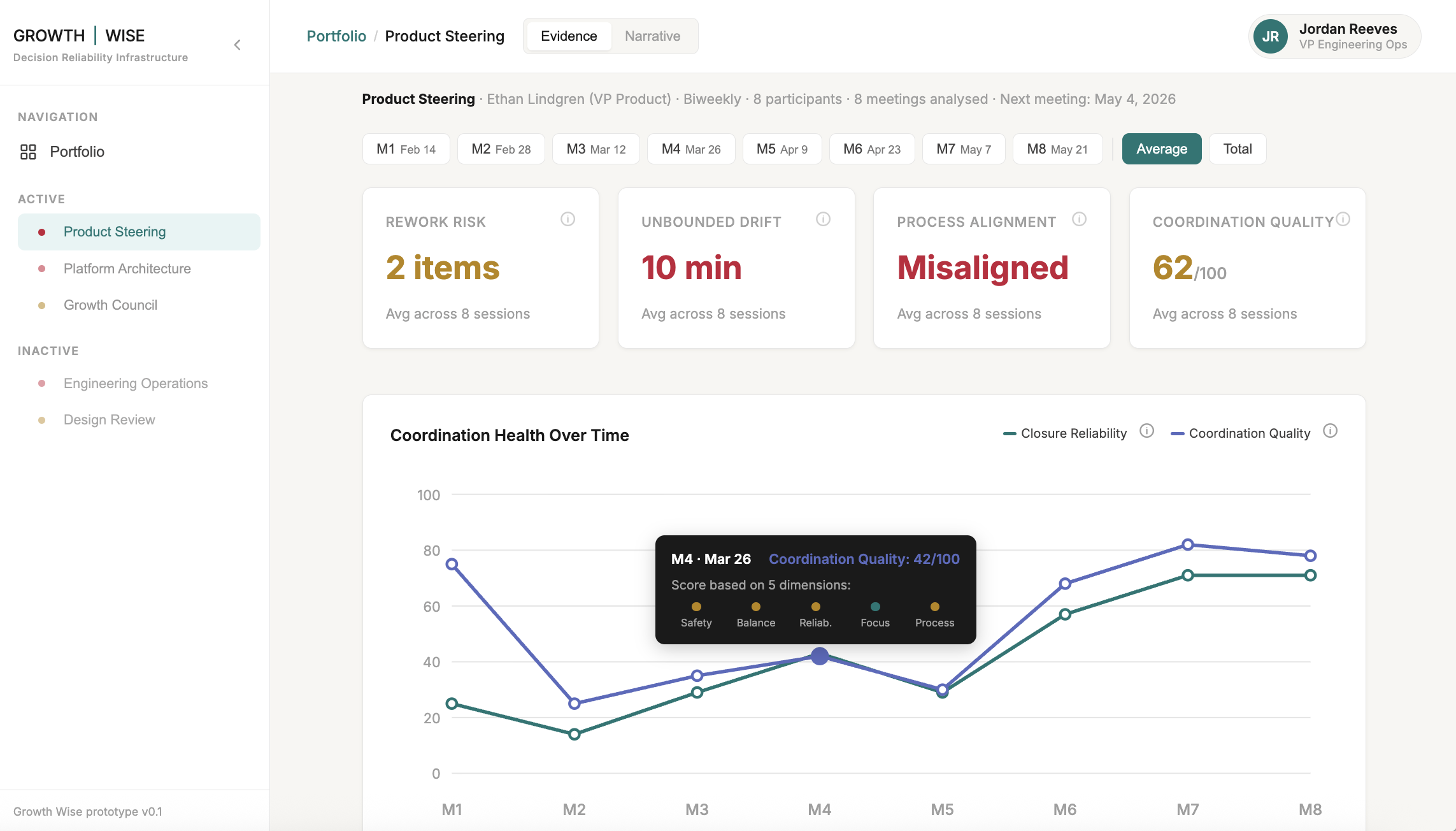
Sample Diagnostic — Sprint PlanningExample
Arena detected
Status Update not Planning
Closure
Partial Decision stated, no owner assigned, no deadline
Decision rule
Absent No rule stated. Group assumed leader-decides but leader deferred.
Drift
Min 12–28 Shifted from planning into solution design. No one named the shift.
Reopen risk
High Same topic discussed in 3 of last 4 meetings without convergence.
Smallest fix
Protocol State decision rule before deliberation. Close with owner + deadline.
Investment
Pricing
Single Meeting Analysis
One meeting. One diagnostic. See what surfaces.
€1kone-time
Diagnostic Money-back guarantee
3–5 meetings. Pattern-level findings. Full refund if they don't land.
€3kcredited to pilot
90-Day Pilot Design partner
Pay in stages: 30% at diagnostic delivery · 40% at protocol installation · 30% at results report
€25k90-day pilot
Risk-free entry
See the value before you commit
Not ready for the full pilot? Start with a Single Meeting Analysis or a Diagnostic. See what surfaces. Then decide.
Money-back guarantee on the Diagnostic
If the Diagnostic doesn't surface patterns you recognize as real — full refund. No obligation.
If you continue to the full pilot, the Diagnostic fee is credited toward the pilot.
Details
Your side
What
Who
Time
Access to transcripts or recordings
Operator
Ongoing
Kickoff call
Sponsor
30 min
Final readout
Sponsor
60 min
Midpoint check-in (optional)
Sponsor
30 min
Sponsor = COO or delegate. Operator = BizOps, Chief of Staff, or Program lead.
We've chosen to co-design with industry leaders rather than build in isolation. You're not testing a half-built product — you're shaping a solution alongside us, so it works for your reality. Professional services maintain quality and rigor throughout.
Your feedback
Sponsor
2 × 30-min feedback sessions
Operator
1 × 60-min workflow session
In return
Feedback incorporated into next iteration
Priority support during the pilot
Lifetime preferred rate locked in at sign-up
If you continue post-pilot, we ask for a joint case study
This is a systems diagnostic, not a performance review. No surveillance. No individual scoring. Just structural clarity about how your meetings actually work.
Mutual NDA before any materials are shared
No transcript storage. Used for analysis, then purged
Guaranteed purge window: 7–14 days after delivery (you set the policy)
Outputs by agreement only. We keep deliverables, or purge everything on request
No individual scoring. Meeting-system patterns, not employee performance
Best fit when
You operate in a matrix and coordination tax is real
Key forums happen virtually (remote or hybrid)
Recurring meetings where decisions are made but follow-through breaks
Not a fit when
You want AI to tell you what decision to make
You want monitoring or performance scoring
Decision-making is purely top-down
Teams work independently — coordination is nice-to-have, not essential
No synchronous meetings to analyze (async-only work)
You're looking for a transcription or meeting notes tool
We design two custom protocols for your forums, coach them with leaders, and rehearse them with teams. This isn't a workshop.
Decision Rule Protocol
"Is this a decision, a debate, or a discussion?"
"Who decides and what rule are we using?"
"What info is required before we decide?"
Close-the-Loop Protocol
"What did we decide?"
"Who owns the next step?"
"By when?"
"How will we know it's done?"
Format: One 30–45 min protocol session with sponsor/leader. One 30 min team walkthrough. Optional 15-min after-action review.
For the budget holder
Low financial risk: Start with a €1k single meeting analysis — or a €3k diagnostic with a money-back guarantee
Milestone-based payments: The full pilot is paid in stages tied to delivery, not upfront
Measurable KPIs: Success criteria are co-signed at kickoff — no ambiguity on what "worked" means
No lock-in: If the results don't justify continuing, you walk away. No obligation.
For data & security governance
Mutual NDA before any materials are shared
No transcript storage — used for analysis, then purged
No individual scoring — meeting-system patterns only
See "How do you handle our data?" above for full details
Start with one meeting
Send one transcript. See what the analysis surfaces. No commitment beyond that.